
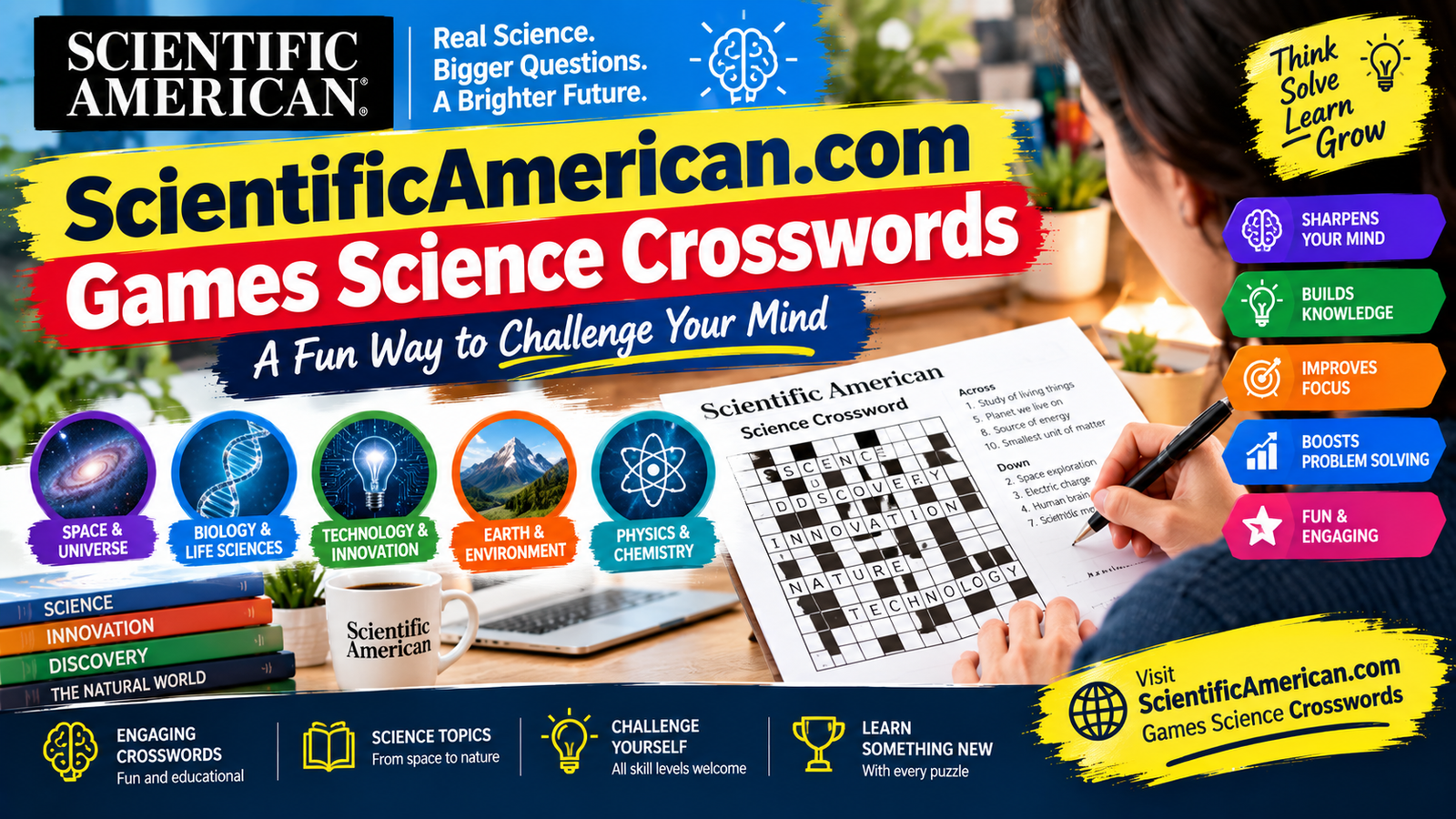
ScientificAmerican.com Games Science Crosswords: A Fun Way to Challenge Your Mind
Science is often associated with laboratories, experiments, textbooks and complex theories. However, learning about science does not always have to be difficult or formal. For people who enjoy solving puzzles while discovering interesting facts, ScientificAmerican.com Games Science Crosswords can provide an entertaining way to exercise the brain and explore scientific ideas.
Science-themed crosswords combine the traditional challenge of crossword puzzles with topics such as biology, astronomy, chemistry, physics, technology and the natural world. They can be enjoyable for students, science enthusiasts and anyone who likes testing their vocabulary and general knowledge.
Why Science Crosswords Are Popular
Crossword puzzles have remained popular for generations because they offer a simple but effective mental challenge. Instead of simply reading information, players have to recall facts, understand clues and determine how different answers fit together.
Science crosswords add an educational element to this experience. A clue might ask for the name of a planet, a biological process, a chemical element or an important scientific term. Solving the puzzle requires both knowledge and logical thinking.
The appeal of scientificamerican com games science crosswords comes from this combination of entertainment and education. Players can enjoy a relaxing puzzle while revisiting concepts they may have learned in school or discovering completely new information.
What You Can Learn from Science Crossword Puzzles
One of the greatest advantages of science crosswords is the variety of subjects they can introduce. A single puzzle may contain clues from several areas of science.
For example, an astronomy clue could involve stars, galaxies or planets, while another clue might focus on genetics or the human body. Chemistry-related clues may include elements, molecules and chemical reactions. Environmental science can introduce terms related to ecosystems, climate and conservation.
Even when a player does not know an answer, looking it up can turn the puzzle into a short learning experience. Over time, repeated exposure to scientific terminology can make complicated concepts easier to recognize and remember.
How Scientific American Games Make Learning Fun
Scientific American is widely associated with science communication and popular science content. Science-focused games and puzzles fit naturally into that educational approach because they allow readers to interact with information instead of simply reading it.
Games can make science feel more approachable. A crossword, for example, does not require a long study session. A person can spend a few minutes solving clues and still encounter useful scientific vocabulary.
This format can also encourage curiosity. When a player encounters an unfamiliar term, they may want to learn more about it. In this way, a simple puzzle can become the starting point for exploring a larger scientific subject.
Benefits of Solving Science Crosswords
Science crosswords can offer several cognitive and educational benefits. First, they encourage memory recall. Instead of seeing information and immediately moving on, players have to retrieve an answer from memory.
They can also improve vocabulary. Scientific fields contain thousands of specialized terms, and crossword puzzles provide a practical way to encounter some of them repeatedly.
Another benefit is problem-solving. Crossword clues rarely give answers directly. Players have to consider word length, intersecting letters and the wording of the clue. This process encourages logical reasoning and flexible thinking.
Finally, puzzles can provide a relaxing form of mental exercise. Completing a challenging crossword can create a sense of accomplishment while keeping the brain engaged.
Tips for Solving Difficult Science Crosswords
Not every science Crossword will be easy. Some puzzles may contain specialized terminology that even experienced science readers do not immediately recognize.
A useful strategy is to begin with the clues you know. Entering a few answers gives you letters that can help solve more difficult clues. Short answers can be particularly useful because they often provide several crossing letters.
Pay attention to the exact wording of each clue. A clue referring to a process, object, person or location may require a specific type of answer.
It is also helpful not to become stuck on one question. If a clue seems impossible, move to another section and return later. The additional letters you discover may make the difficult answer obvious.
Science Topics Commonly Found in Crosswords
Science crossword puzzles can cover almost any scientific field. Some of the most common categories include:
- Astronomy: planets, moons, stars, galaxies and space exploration.
- Biology: cells, organisms, genetics, evolution and ecosystems.
- Chemistry: elements, compounds, molecules and reactions.
- Physics: energy, motion, forces, matter and fundamental concepts.
- Earth science: geology, oceans, weather and Earth’s atmosphere.
- Technology: inventions, computing, engineering and modern innovations.
- Environmental science: climate, biodiversity, conservation and natural resources.
This broad range keeps puzzles interesting because players never know exactly what subject may appear in the next clue.
Science Crosswords for Students and Teachers
Educational puzzles can be especially useful in classrooms. Teachers can use science crosswords as supplementary activities after introducing a new topic. Students can review important terminology without feeling as though they are taking another conventional test.
For students, puzzles may also reveal which concepts they understand and which terms need additional study. A crossword should not replace structured learning, but it can work well as a review activity.
Parents can also use science puzzles as an informal way to encourage children to explore scientific vocabulary. When approached as a game rather than homework, learning can become more enjoyable.
Making Puzzle Solving Part of Your Routine
You do not need to spend hours solving crosswords to benefit from them. Setting aside 10 or 15 minutes a few times a week can provide a convenient mental exercise.
You might solve a puzzle during a quiet morning, while taking a break from work or as part of an evening routine. The important thing is consistency and curiosity.
Keeping a small list of unfamiliar scientific terms can make the activity even more useful. After completing a puzzle, research a few words you did not know. This transforms a crossword session into a short self-directed science lesson.
Why Scientific Games Are Worth Exploring
Scientific games demonstrate that education and entertainment can work together. Rather than presenting scientific information only through traditional articles or lectures, games encourage people to participate actively.
The scientificamerican com games science crosswords concept is appealing because it brings together curiosity, vocabulary, memory and problem-solving. Whether you are already passionate about science or simply enjoy puzzles, science crosswords can offer a rewarding challenge.
They can also encourage lifelong learning. Science is constantly developing, and puzzles can motivate people to explore subjects beyond their existing knowledge.
Conclusion
Science crosswords are more than ordinary word puzzles. They combine entertainment with scientific vocabulary, factual knowledge and mental exercise. For students, they can be useful review tools; for adults, they can provide an enjoyable way to keep learning; and for science enthusiasts, they offer another opportunity to explore fascinating subjects.
If you are searching for scientificamerican com games science crosswords, the key appeal is the chance to make science interactive and enjoyable. Solving clues, connecting answers and discovering unfamiliar concepts can turn a few minutes of puzzle solving into a meaningful learning experience.
Whether you are interested in astronomy, biology, chemistry, physics or the environment, science-themed crosswords provide a simple way to challenge your mind while staying curious about the world around you.